Event Calendar

 
Filter…
reset
Targetgroup
Event-Type
Date
reset
21.Sep
9:00
building 20.30, room 0.014
Jan Stühmer (HITS/KIT), İsmail İlkan Ceylan (TU Vienna, AITHYRA), Joel Oskarsson (ETH), Arghya Bhowmik (DTU) and Petar Veličković (Google DeepMind)
The program of this year's summer school will focus on Graph Neural Networks, covering both fundamental concepts and practical applications.
Participants can expect a mix of lectures and interactive sessions that provide insight into the mathematical foundations as well as real-world use cases of graph-based machine learning methods.
 
KCDS members as well as doctoral researchers from KIT and other universities/ research centers are welcome to join! There is no participation fee. Please note that KCDS doesn't cover travel and accomodation expenses.
12.Oct
9:30
KIT Campus South
Richard Samworth, University of Cambridge, Professor of Statistical Science and Director of the Statistical Laboratory
Workshop: October 12+13, 2026 - places limited, registration necessary Poster session: October 12, 2026, 4.45 pm, KIT Campus South, Building 10.81, in front of the Theodor-Rehbock-Hörsaal (HS59). Posters will be presented by workshop participants. Attendance without presenting a poster is possible without registration. Keynote lecture: October 13, 2026 at 4.30pm, KIT Campus South, NTI Lecture Hall - no registration  
For more than two centuries, least-squares regression has been a cornerstone of statistical practice, while classical nonparametric smoothing methods have long served as standard tools for analysing complex data. In this workshop, we will revisit these methods from a modern perspective and ask: Are we making the best possible use of them? Recent work in statistical theory by Richard Samworth and others shows that these familiar methods can often be improved by incorporating additional structural information, such as shape constraints or properties of the underlying error distribution.
 
This two-day workshop, led by Richard Samworth, will explore recent developments in distributionally adaptive statistical methods. Richard Samworth is Professor of Statistical Science and Director of the Statistical Laboratory at the University of Cambridge. A Fellow of the Royal Society, he is the recipient of numerous distinctions, including the COPSS Presidents' Award, the David Cox Medal, and, in 2025, the Royal Statistical Society Guy Medal in Silver. His research has made fundamental contributions to nonparametric statistics, statistical learning theory, and high-dimensional methodology, particularly in shape-constrained estimation and adaptive nonparametric procedures. A defining feature of his research is the combination of rigorous theoretical guarantees with methods designed to be computationally efficient and practically applicable.
 
The first day will focus on linear regression and shape-constrained estimation. Starting from the classical least-squares framework, the workshop will examine how structural information, including monotonicity, can be used to improve estimation and inference. The second day will turn to nonparametric regression. It will begin with local polynomial methods and their theoretical foundations before introducing recent extensions, including Outrigger local polynomial regression, which adapts to the underlying error distribution while retaining strong theoretical guarantees.  
The theoretical lectures will be complemented by practical sessions in R and Python, allowing participants to apply the methods discussed during the workshop. A joint poster session, with a particular focus on early-career researchers, will provide an opportunity to present ongoing work, exchange ideas across disciplines, and receive feedback from other participants and senior researchers. The poster session on Monday and the plenary talk on Tuesday will also be open to researchers from the university and neighbouring institutions.
 
The workshop is primarily intended for doctoral candidates and postdoctoral researchers from the KCDS Graduate School and the Heidelberg Graduate School MathComp, as well as members of the Helmholtz Association and researchers in related fields who have a strong interest in modern mathematical statistics.
Participants will gain insight into current developments in adaptive statistical methodology and their connections to broader challenges in statistical learning and modern data analysis.
 
The workshop and keynote lecture are organized by the Institute of Statistics (STAT) in cooperation with MathSEE / KCDS and HGS MathComp at Heidelberg University. The workshop was made possible through Course Funding from HIDA, which supported its development and implementation.
13.Oct
16:30
KIT Campus South, NTI Lecture Hall (building 30.10)
Richard Samworth, University of Cambridge
The workshop for registered participants is complemented by a keynote by Richard Samworth to which everyone interested is invited, no registration necessary!
 
For more than two centuries, least-squares regression has been a cornerstone of statistical practice, while classical nonparametric smoothing methods have long served as standard tools for analysing complex data.  In this workshop, we will revisit these methods from a modern perspective and ask: Are we making the best possible use of them? Recent work in statistical theory by Richard Samworth and others shows that these familiar methods can often be improved by incorporating additional structural information, such as shape constraints or properties of the underlying error distribution.
 
Richard Samworth will explore recent developments in distributionally adaptive statistical methods. Richard Samworth is Professor of Statistical Science and Director of the Statistical Laboratory at the University of Cambridge. A Fellow of the Royal Society, he is the recipient of numerous distinctions, including the COPSS Presidents' Award, the David Cox Medal and the Royal Statistical Society Guy Medal in Silver in 2025. His research has made fundamental contributions to nonparametric statistics, statistical learning theory, and high-dimensional methodology, particularly in shape-constrained estimation and adaptive nonparametric procedures. A defining feature of his research is the combination of rigorous theoretical guarantees with methods designed to be computationally efficient and practically applicable.
 
Richard Samworth will present recent work with Elliot H. Young and Rajen D. Shah on "Outrigger local polynomial regression“. A preprint of the paper is available on arXiv https://arxiv.org/abs/2603.11282.

Upcoming and Recent Events

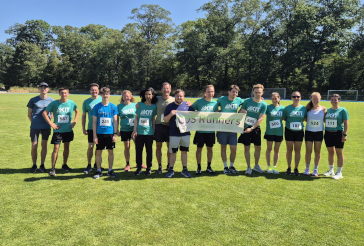
CDS Runners - running as a team at 12th KIT MeisterschaftUwe Ehret
CDS Runners @ 12th KIT Meisterschaft! (July 4, 2026)

The CDS Runners team ran like the wind at the 12th KIT Meisterschaft, a 10km fun run at KIT Campus South and, thanks to the fastest four runners in the team, came in as team 13 of 59! Congratulations!

AI-generated image of an eye, surrounded by a network of lines symbolizing a neural network
AI Perspectives vol. 2 (July 8, 2026)

The AI Community at KIT is active, but spread-out: KIT Centers MathSEE and KCIST aim to bring AI researchers together in this joint workshop. Join us at Triangel Space for inspiring talks by Benjamin Unger, Maria Francesca Spadea and Tobias Käfer and show your AI-related research at our poster session.


Call for poster contributions now open!

More info, registration, poster submission
AI-generated, symbolic image of a graph neural network, with the words KCDS 2026 Summer School Graph Neural Networks on top
KCDS Summer School on Graph Neural Networks (Sep 21-25, 2026)

In this year's summer school, we will cover both fundamental concepts and practical applications of Graph Neural Networks. Participants can expect a mix of lectures and interactive sessions that provide insight into the mathematical foundations as well as real-world use cases of graph-based machine learning methods.

More info and registration
View from the Hohlohturm in the Black ForestHarke, CC BY-SA 3.0 , via Wikimedia Commons
KCDS Retreat 2026

This year's group retreat will be from November 2-4, 2026 at the Black Forest. Save the date!

More info
A signpost pointing to "Past" and "Future" Hadija on Unsplash
Timeline

Find an overview of past events in our timeline.

link

Highlights

Visualization of a stochastic PDE
Pathways into Mathematics of SPDEs: A Workshop for Young Researchers 2026

The workshop was co-organized by doctoral researchers from HGS MathComp (Heidelberg) and KCDS and provided a smooth introduction to a challenging, yet highly relevant topic: Stochastic partial differential equations in applied mathematics. It took place from March 9-11, 2026 in Heidelberg.

More info
Workshop on Statistics and Data Science for Climate and Weather Extremes
Workshop: Statistics and Data Science for Climate and Weather Extremes 2025

A worthwhile journey to KIT Institute of Statistics: Talks by Sebastian Engelke, Linda Mhalla, Gabriele Messori, Petra Friederichs gave insights into state-of-the-art research in statistics and data science for climate and weather extremes. The workshop took place on November 20, 2025 at the Campus South outpost in Blücherstraße.

Read more here
KCDS group at the retreat 2025
KCDS Retreat 2025

A friendly place in the Black Forest, sunny autumn weather, good food, lively (scientific) discussions, board games and activities ranging from powerpoint karaoke to trampoline jumping were the ingredients of a lovely KCDS Retreat this year! It took place from November 10-12, 2025.

Read more
Wavy lines, designed by FreepikFreepik
KCDS Summer School 2025

Short courses and an interactive tutorial on Neural Operators and Gaussian Processes, along with a poster session and lots of opportunities for networking with other researchers - that was the KCDS Summer School 2025! It took place from August 27-29, 2025 at KIT Campus South.

Read more
Prof. Victoria StoddenVictoria Stodden
Report: Reproducibility Workshop with Prof. Victoria Stodden

KIT International Excellence Fellow Prof. Victoria Stodden invited the KIT community, especially early career researchers, to create ideas and proposals for facilitating research that is data-, compute-, or AI-enabled - taking reproducibility to action! The workshop took place on January 21, 2025 at Triangel Studio.

Read more
Panel discussion with KIT Alumni at Triangel Space
Report: Career Talk with KIT Alumni 2024

From Computational and Data Science to Industry and Academia - four KIT Alumni gave insights into their jobs during a lively panel discussion on October 11, 2024 at Triangel Space.

Read more
Group picture of the participants of the RainQuest Hackathon 2024
Report: RainQuest Hackathon 2024

The hackathon on precipitation estimation with weather radar and rain gauge data took place from October 8-11, 2024 at Triangel Studio.

Read more

About KCDS

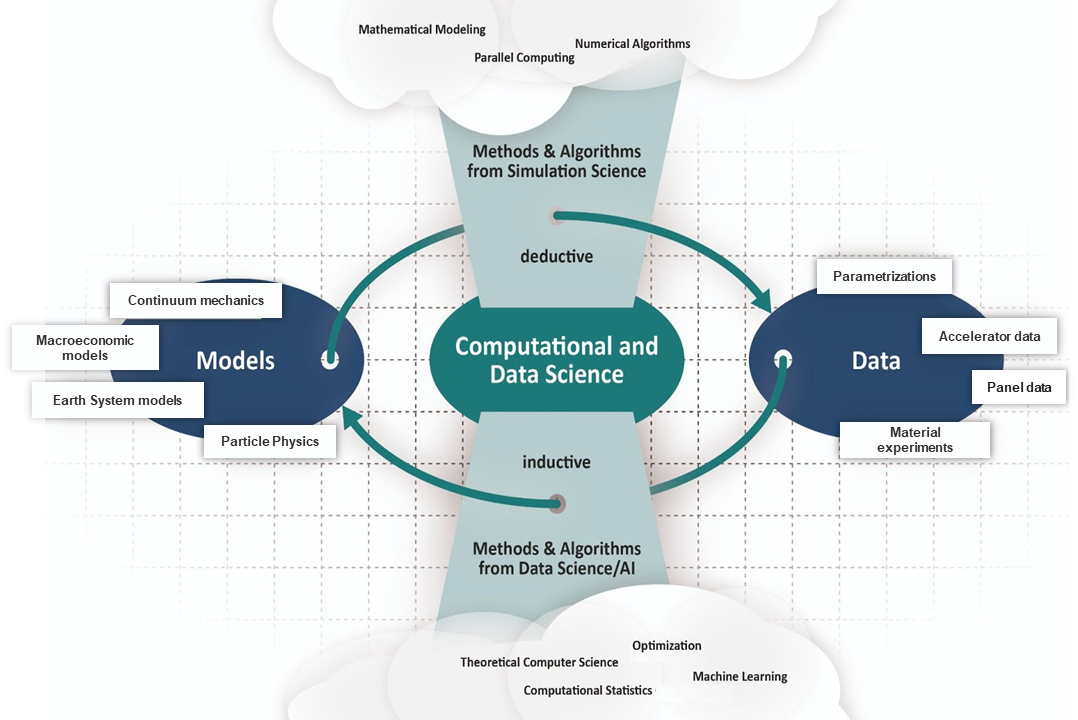
Concept of the graduate school KCDS
KIT Graduate School Computational and Data Science (KCDS) is a graduate school at KIT Center MathSEE that offers an interdisciplinary training program for doctoral researchers in the field of model-driven and data-driven computational science.
In this unique program, doctoral researchers will be able to conduct an interdisciplinary research project that revolves around computational methods such as mathematical models, simulation methods and data science techniques, all the while building bridges between mathematical sciences and an applied SEE discipline (science, economics and engineering).
Addressing global challenges, the school provides a wide variety of topics, from meteorological ensemble forecasting to machine learning in elementary particle physics.
At KCDS, doctoral researchers have one supervisor from the mathematical sciences and one from the applied discipline. They are part of a dynamic community and participate in the school’s interdisciplinary training program, including hands-on training in small groups, summer schools, networking events and hackathons/datathons.
Thinking simulations and data together, we are ready to conquer the data-driven challenges of tomorrow!

Coordination Office